AI is blowing up many different sectors of business and changing how we see work. There is a large amount of discussion around possible job loss, and with all of the efficiency and value that automation will provide, it creates legitimate concern over job loss and how we see the future of our workforce. Many people have mixed feelings about the issue; it is a multidisciplinary discussion which incorporates different aspects of technology as well as economics and sociology.
In order to have a complete picture of what AI means for the labour market going forward, it is important for all people working today in the labour market (lawyers and business executives, government agencies, and others) to fully educate themselves on the overall picture of AI and its implications.
This article will discuss how AI works, what AI will do to various sectors of business, and how AI is changing the relationship between human workers and machines as they become more integrated into the workplace.
1. What Is Artificial Intelligence (AI)?
Machines simulating human intelligence processes are termed as Artificial Intelligence (AI), and machines that simulate human intelligence processes, are AI processes. AI processes consist of learning, reasoning, problem solving, perception, and communication. Artificial Intelligence is a collection of technologies and capabilities, as AI is an umbrella term for many technologies that can perform many tasks. Some of these technologies may fall under subfields such as Machine Learning, which allows computers to learn based on experience using algorithms and Natural Language Processing, which gives AI the ability to read, write, and produce words in human language.
The main goal of the development of AI is to allow machines to perform tasks that humans would typically do. Tasks performed by humans vary greatly and can include automated repetitive tasks that require rule-based decisions as well as complex decision-making in environments of uncertainty. To better explain the difference between these types of systems, we need to clarify the difference between Narrow AI, which can perform a specific task (e.g., Recommendation Algorithms, Recognition Algorithms) versus General AI, which will have the ability to adaptively learn new tasks across a wide range of domains. Currently, most workplaces use Narrow AI because they excel at optimizing processes that are clearly defined.
2. How Does Artificial Intelligence Actually Work?
AI collects a lot of information that is analyzed for connections and similarities. With this information, AI can create predictions and/or decisions. A computer that can use a learning methodology to generate AI is called machine learning. Machine learning allows AI to build knowledge of past events without being told or manually changing the computer’s programming for each new set of circumstances. For example, machine learning has been used to develop AI that uses millions of labeled photographs to learn about an animal called a cat, then uses that learning to identify cats in previously unknown images that are not labeled.
Neural networks provide the foundational building blocks for AI systems. Although neural networks were created using the function of the human brain as a model, they are actually networks of algorithms, not neurons, that are connected together to process input data. By using an advanced technique called deep learning, neural networks can identify complex patterns of data such as speech or text and images. Therefore, AI is used to convert a lot of data into meaningful, actionable intelligence that can automate tasks and enhance the abilities of humans in many areas, including health care and finance.
3. How Will Artificial Intelligence Affect Jobs and the Economy?
AI’s influence on the economy will have short- and long-term implications. In the near-to-mid-term horizon, many AI capabilities will allow for the replacement (or automation) of certain job functions within an individual’s current role, thus transforming how people work. Productivity increases and greater economic growth can occur due to automation of job duties, which should lower prices and give rise to rapidly emerging industries and services that are not yet completely clear to us. Historically, new technologies have replaced or caused the disappearance of some forms of work, yet they ultimately lead to even greater employment than was lost.
Although the potential for AI’s impact on the economy may appear positive, it may also present additional challenges for workers in those types of routine and repetitive job functions. For example, if the majority of the productivity gains generated by the implementation of AI are realized only by certain organizations, the consequent inequity will be compounded by the creation of fewer jobs for those unable to transition into a different type of job. As a result, the greatest challenge to the economy as a whole will be the management of the transition resulting from the implementation of AI. Therefore, governments must provide assistance to organizations and workers who are affected by the transition through appropriate legislative policies to provide for reskilling programs, a strong social safety net, and the development of new roles based on human qualities and skills augmented by AI technology.
4. What Jobs Are Most Likely to Be Automated by AI?
Positions focused on data-driven and repetitive coordination are generally the easiest targets for AI Automation. In particular, the largest areas of target include:
- High-Volume Data Processing Jobs: Bookkeeping/accounting positions, Data Entry Clerks, and specific types of Analysts primarily exist to collect and connect around large amounts of structured data.
- Repetitive and Routine Customer Support: Customer Care Representatives, primarily through cold calling and basic supports, are well suited for replacement by Chatbots and Virtual Assistants.
- Repetitive Manufacturing and Production Duties: Many of these type jobs are repetitive consist of multiple use of hand movements and quality-assurance inspections, for which Robots and Machine interfaces provide a superior and faster response.
- Generative Content Production: Some writing jobs such as, the writing of very straight financial reports, sports summaries, and product descriptions, are also likely to become automated by AI tools.
These jobs will continue to be replaced by AI until there is little to no manual, repetitive action and/or more complicated, higher-level Creative Intelligence or Social Intelligence (CI or SI) is required in completing that work.
5. What Jobs Will Not Be Replaced by Artificial Intelligence?
Certain professions have a strong reliance on human capabilities and therefore will be much less likely to be fully automated than other occupations. Most importantly, all of the following career fields involve:
- Complex Creative and Strategic Innovation by the production of truly Novel Ideas and/or Concepts and/or Artistic works. (e.g. Scientists, Novelist, Artists, and Senior Level Strategists).
- Complex Social and Emotional Intelligence. (i.e. High Level of Empathy, Nuanced Persuasion, Relationship Building). Examples: Mental Health Therapist, Social Worker, Nurse, Teacher.
- Unpredictable Physical Work, Problem Solving, and Dexterity. (i.e. need to Adapt in Unpredictable Situations, High Level of Fine Motor Skills). Examples: Plumber, Electrician, Surgical Specialist.
- Complex Ethical/Moral Judgments and Decision Making. (i.e. Making Judgments or Having Implications that Involve Ethics). Examples: Judge and/or Ethical Oversight Board and/or Senior Level Management.
These career fields clearly represent examples of “safe jobs from artificial intelligence,” because they indicate that human strengths in Creativity, Emotional Connection, and Contextual Understanding & Moral Reasoning create a very high barrier for future automation.
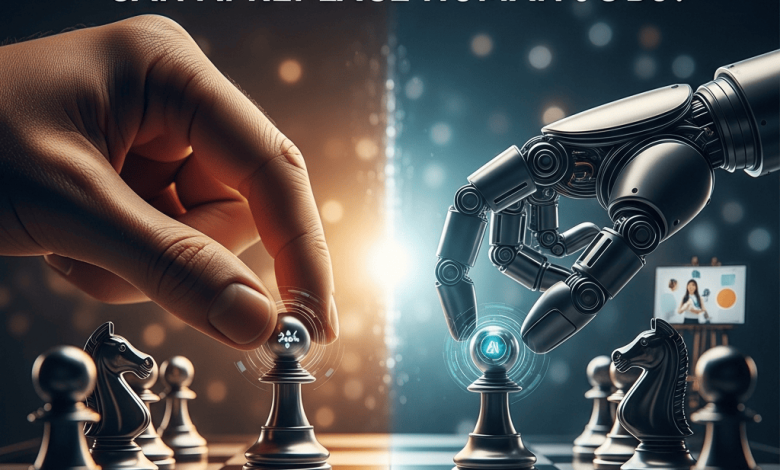
The future will require ongoing human-AI collaboration, where machines will be utilized to perform Data Processing and/or Routine Tasks that free humans to perform Higher Order Functions.
6. How Many Jobs Could AI Replace by 2030?
The predictions for job loss through AI differ significantly between the many research organizations in how they are calculated, as they use different methods and/or assumptions. As one example, a much-quoted report by McKinsey Global Institute predicts that up to 30% of total global hours worked by humans could potentially be done by way of automation by 2030 due to a quicker increase in the uptake of AI technology. While this is significant, it does not indicate that this will happen to everyone in every industry, but rather, that the nature of what kind of work people do and the skills they will need to do these jobs will change dramatically.
The total impact on employment numbers will be largely determined by the speed at which new employment opportunities are generated, after having been created in previous technology intensity shifts.
Some experts believe there will be a decrease in traditional positions due to technology advances, whereas new types of employment positions are likely to emerge, e.g., AI trainers, compliance managers for ethical behavior, and automation specialists, along with other jobs that will come from an expanding economy as a result of new technology.
The degree to which workers are displaced will vary significantly between different sectors, regions, and the degree to which countries develop effective reskilling programs for workers transitioning to a new and expanding business segment.
7. What Are the Key Benefits of AI in the Workplace?
Artificial Intelligence (AI) has the potential to drastically change the workplace; when implemented thoughtfully, AI provides the most value by assisting humans in their work, rather than simply replacing it. One of the most significant benefits of AI is the ability to automate repetitive and mundane tasks, enabling employees to move away from repetitive administrative positions and move toward more creative, strategic, and interpersonal positions, which should increase both productivity and job satisfaction.
As an external source of knowledge, insight, and enhancement, AI gives humans more capabilities to utilize than they otherwise would have available to them. AI will allow corporations to analyze large data sets to generate insight for improved decision-making, assist in complex design or advanced engineering, and facilitate real-time translations in order to eliminate language differences.
Additionally, businesses are now able to supply their employees with a variety of individualized development opportunities through AI-supported tools and create a highly skilled and flexible workforce.
Therefore, the overall outcome of AI in combination with humans is enhanced productivity, since machines can support and perform the heavy lifting of computing, thus allowing human beings to focus on what they excel at best.
8. How Can People Embrace AI and Learn Skills for the Future?
To be successful in an AI-enhanced work environment requires people to take a proactive approach to lifelong learning and the development of new skills. To future-proof your skills, focus on developing those skills which will complement AI rather than compete with it. Human beings will always be better than AI at many things, particularly when it comes to but not limited to Critical Thinking, Complex Problem Solving, Creative Thinking, and Emotional Intelligence.
On a practical level, the best way for individuals to be ready for an AI-enhanced workplace is to find out how the AI tools available to them, including their specific industry, work and how to use them.
To that end, all Individuals should engage in the reskilling process through such methods as taking on-line courses, vocational training, and/or getting degrees from accredited institutions in such fields as Data Science, Cybersecurity, Healthcare, etc.
Also developing an Adaptable Mindset and a Commitment to Continuous Learning will also be the most important skill you can acquire in being ready to leverage technological advances to your career advantage.
9. What Are the Most Common Questions About AI Replacing Human Jobs?
Will AI lead to extensive job loss? Most economists think this is very unlikely; rather, AI will alter the market significantly over time by replacing jobs, but AI should also create job opportunities. However, the transition into these new occupations from old occupations will be difficult.
Is my job safe? It depends on the type of tasks you do in your profession. If it’s primarily focused on repetitive, predictable tasks, you’re probably at risk. However, if you need to think creatively, work well with others, and make complex decisions; then you’re likely to be safe in your job.
Can AI create things? Currently, yes; however, an AI can only create new combinations of data and imitate some aspects of creativity, like making music or art from previous information, but it can’t actually think or have human-like depth to their experiences, thus making it difficult for them to make radical advancements in areas like creativity.
When will these changes occur? Automation will continue to occur, as this is not a one-time event. The pace at which companies adopt automation will vary by company and the different costs associated with it. A larger transformation will begin within the next 10 years, but automation will continue to be introduced on a case-by-case basis beyond that time frame.
Final Thoughts
AI creating new work environments does not create an either/or situation. Instead, it creates an enhanced form of work that combines the human element and AI. The most likely scenario will have AI taking care of the repetitive nature and computational/density of data tasks, thus increasing the productivity of people by empowering them to spend their time creating, nurturing, planning, and connecting with others.
To achieve this transition, we all (individuals, businesses & governments) must obtain a shift by making an investment in learning and implementing policies that offer strategies to reskill the workforce. The only way for a seamless transition to occur is if we commit to be knowledgeable in the areas of ethics and ethical practices with regards to the use of AI within the workplace. By doing this, we will create opportunities for AI to assist with human welfare while transitioning the work we perform into higher-level activities.
